 |
| Nuku Hiva City Pictures Org |
It’s such a Victorian story that it feels like you should be sitting in petticoats, quill and sealing wax in hand, writing words like ‘natives’. Predictably, The Daily Mail and The Sun in the UK jumped at the story, showing just what happens to the civilised in foreign parts. The people of Nuku Hiva are horrified at the allegations of cannibalism. A local journalist, Alex du Prel, says that the islanders’ revival of old traditions hasn’t gone that far. “French civilisation has taught these people to eat cheeseburgers and canned food, not people,” he told the international press.
Nuku Hiva hasn’t had a murder in a hundred years, and the death of Stefan Ramin has shocked the population of just over 2,000 people, 5% of whom are French. Whatever the veracity of the cannibalism claims, Stefan Ramin’s death is extremely fishy.
 |
| Stefan Ramin and Heike Dorsch Sky News |
The 40-year-old German was obsessed with sailing and water sports, and was on a trip of a lifetime with his girlfriend. Landing in Nuku Hiva, he went on a goat hunt with tourist guide Henry Haiti, and never came back. His girlfriend, Heike Dorsch, claims that Haiti told her there had been an accident, assaulted her, tied her to a tree and fled. He has not been seen since, and a week later, human remains were found. They had been burnt and dental records identified them as those of Mr Ramin. Where does the cannibalism story come from? Bild, the German version of The Sun, claims police are suspecting cannibalism. The basis for this seems to be that once upon a time the Polynesian people were cannibals, and that Haiti had a tattoo of a cannibalistic tribesman.
 |
| Henry Haiti Nine News Australia |
It’s possible that Mr Ramin was killed accidentally and Haiti panicked and burned the evidence. Or perhaps it’s just a straightforward case of murder. But cannibalism? Surely that just happens in stories?
Well, up until the 19th century, cannibalism did happen in the Pacific, including on Nuku Hiva. The reasons that ancient tribes consumed the ‘long pig’ are varied. Some contend it was simple matter of survival. Others see it as a ritual humiliation of enemies, or a way of honouring the dead, or a way of absorbing the traits of the brave or admired. One theory on cannibalism in the South Pacific suggests that overpopulation on the islands left the people with little other choice.
Well, up until the 19th century, cannibalism did happen in the Pacific, including on Nuku Hiva. The reasons that ancient tribes consumed the ‘long pig’ are varied. Some contend it was simple matter of survival. Others see it as a ritual humiliation of enemies, or a way of honouring the dead, or a way of absorbing the traits of the brave or admired. One theory on cannibalism in the South Pacific suggests that overpopulation on the islands left the people with little other choice.
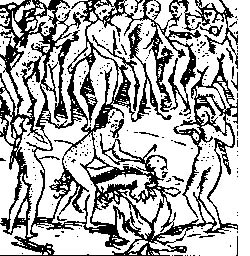 |
| Cannibalism in 16th century Lehigh University |
But it was definitely exaggerated by colonisers, and used as an excuse to ‘civilise’ the ‘savages.’ William Arens, writing in the 1970s, claims that there was little or no cannibalism in the Pacific. He believed that evidence of it was usually reliant on hearsay, a sort of colonial urban legend. Most anthropologists today agree that there was some prevalence of cannibalism in the Pacific, although it was nowhere near as rife as previously thought.
The Korowai tribe in Papua New Guinea are reportedly the last cannibalistic tribe in the Pacific. They lived totally isolated from the rest of the world until the 1970s, and are believed to eat social outcasts, like witches. Yet, some believe that the Korowai no longer practise cannibalism, and are in fact putting it on for the benefit of tourists.
Before we jump to conclusions on the savages of the Pacific, we should look at the mote in our own eye. There was some prevalence of cannibalism everywhere at one time in history. In the case of Europe it was a very long time ago- evidence in Britain’s Cheddar Gorge shows that humans practised cannibalism regularly in order to survive the Ice Age. French and German sites prove the same. And human sacrifice was once rife across Europe, including in Ireland.
The Korowai tribe in Papua New Guinea are reportedly the last cannibalistic tribe in the Pacific. They lived totally isolated from the rest of the world until the 1970s, and are believed to eat social outcasts, like witches. Yet, some believe that the Korowai no longer practise cannibalism, and are in fact putting it on for the benefit of tourists.
Before we jump to conclusions on the savages of the Pacific, we should look at the mote in our own eye. There was some prevalence of cannibalism everywhere at one time in history. In the case of Europe it was a very long time ago- evidence in Britain’s Cheddar Gorge shows that humans practised cannibalism regularly in order to survive the Ice Age. French and German sites prove the same. And human sacrifice was once rife across Europe, including in Ireland.
 |
| John Tradescant the Younger. Botanist and skull enthusiast, his image is the cover of Dr Sugg's book. Wikipedia |
And as recently as the 17th century, the fad for ‘corpse medicine’ was at its height in Europe. Blood, flesh and bones were taken as a cure for a number of ills. British aristocracy especially favoured ‘skull moss’- moss gathered from the skulls of those who had died on battlefields. Irish skulls were favoured, being abundant due to constant rebellions and battles. It was snorted through the nose or crushed to powder and drunk in medicine. And according to the recently published Mummies, Cannibals and Vampires by Dr Richard Sugg, it went on until well into the 19th century- reportedly the young Hans Christian Anderson saw a child being given a cup of blood from the condemned at an execution. All in the name of medicine, just like the Pacific islanders thought eating others would give them strength.
 |
| .... Mexicolore.co.uk |
So maybe before we automatically label Henry Haiti a cannibal, we should remember that they only stopped eating people the same time we did.

No comments:
Post a Comment