Our Finance Minister Michael Noonan got himself into trouble recently by calling emigration a lifestlye choice. He was right in one way: the emigration besetting Ireland now is a very different beast to the emigration undertaken by, say, John F. Kennedy’s great-grandfather Patrick. Patrick faced a stark choice- starker than anyone today could imagine. He was the third son in line to inherit a tiny family farm during the Famine. He knew that he would never own the farm and therefore make a living from it. So it came down to this- take a potentially fatal voyage three thousand miles across the Atlantic Ocean in a wooden ship that doubled as a morgue, or stay in Ireland and starve to death. When you put it into this perspective, today’s emigration is definitely a lifestyle choice.
Emigration never stopped after the Famine, apart from thirteen brief years, starting in 1995 and ending, for definite, in 2008. This little interlude in a thousand years of mostly unremitting poverty was called the Celtic Tiger, and it was when my generation came of age. Older people, who can remember the 80s, watched us with shock and envy. They scoffed when some of us played at being pretentious rich kids from Chelsea who had been reared on champagne as mother’s milk. When in reality, we were from townlands called Knockardandrum and grew up squashed seven to a backseat of an 89 Nissan Sunny.
Most of us weren’t like that. The Tiger didn’t roar at everybody, nor did he turn everyone’s head, but my generation felt with some assurance that we were going to get a job out of all this economic success. It was the least we could expect, after all. It was what Bertie was telling us every night on the Six-One.
 |
| Danielle, third from left, at her graduation from UL via Facebook |
Danielle O’Driscoll, 22, from Ballylongford in Co Kerry, did her Leaving Cert in 2007. The school-leavers of that year, incredible as it may seem now, were told that their futures were bright. Filling out CAO forms blind to the fact that courses like architecture and Arts would be soon be a shortcut to the dole, they were the last year choosing careers because they were what they wanted to do. Danielle chose Arts in UL, a brand new course in that university. The eldest of four, she graduated last August. A week later, she was on a plane to Perth, Western Australia. Her boyfriend Brian, a fully qualified electrician, had left months earlier.
“Let’s face it, an Arts degree isnt worth a whole lot without a Masters,” she says. “I didn’t really want to just do a Masters for the sake of it and I always wanted to travel a bit so it just seemed like the perfect opportunity.”
Danielle had an advantage over the thousands who have moved to Australia in the last few years. Moving there is an expensive business and you need to be certain it’s for you before you leave. As Danielle points out it’s not like England, which is a short plane ride away. Luckily for her, as part of the Study Abroad programme that is a core part of UL’s humanities modules, she lived in Perth for six months in 2009.
Brian went with her, along with two other friends from college. He fell in love with the lifestyle, and she too liked Australia. “I knew what the culture was like and knew exactly what I was letting myself in for this time,” she says of her return visit.
Asides from the weather, which is an obvious attraction to life in Australia, she says there is truth to the stereotype that the Aussies are far more laidback and straight-talking than the Irish. “There’s no sense of urgency or worry,” she says. The Australians have little time for nonsense, which also appeals to her.
“Everybody is not afraid to be themselves. Even the most stuck up person from home becomes the most chilled out chick here,” she says. “Australia, as a country, has no time or willingness to deal with those who have airs and graces about themselves. Personally I’ve meet and become friends with people from home whom I have known to be all about themselves whilst in Ireland... and its as if by a beam of sunlight the sh*t is just knocked out of them.”
The biggest disadvantage of living in Australia is its distance from Ireland, she says. “If anything were to happen at home, both good or bad, it takes a day to get home and that providing you can get flights straight away.”
Danielle misses her family too. Her younger twin brothers started college too this year, one in UL and the other in IT Tralee. It means that her mother and little sister, who is nearly five years old, are now the only ones left at the family home.
It’s the people in Ireland she misses, rather than the country itself. “Do I miss the people I left behind? Everyday!” she says. “I miss being in the environment where I walk over the road and be at my best friend’s house for a cup of tea, or catching up with everybody on a Friday night in the local pub or meeting up with the college crew in a cafe for hot chocolate or a few drinks. I am from a very close knit family and having to battle the technical issues of Skype each time I talk to them can be very testing to even the most patient of people!”
There are things she definitely doesn’t miss about Ireland however. Like many of her generation, the relentless negativity was starting to get her down. “Do I miss the ever-depressing talks of the recession and the potential crashing of the eurozone? No! Do I miss having to work two or three jobs to earn a substantial wage? Hell no!”
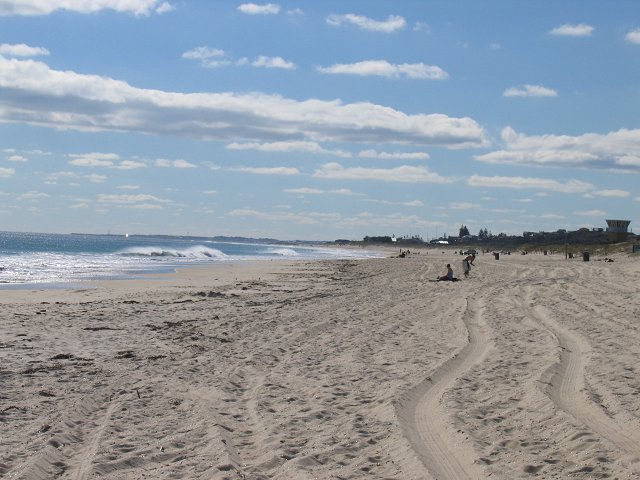
It’s hard to argue with someone who has swapped the misery of Ireland’s current situation for a life in a country where sunshine and jobs are plenty. But she is at pains to stress that anyone going to Australia should not think it is the promised land. The cost of living is high, and while employment is plentiful for tradesmen, work is not so forthcoming for girls and those without a trade. Her boyfriend is currently working in the mines in Karratah, 1500 km north of Perth. Danielle is working at hotel overlooking Scarborough beach. The beaches crystal blue waves, just wild enough for surfing, and golden sands make it the very epitome of Australia.
“It may seem like a good idea until you get here and realise, I’m on my own now!” she says. “If you have a trade it’s a lot easier to get a good job. Unfortunately for women, its quite hard to get a good job straight away - just because the tradespeople are the most sought after.” She also advises people not to overstay their visas, as the Australian authorities are very strict. “If you come here on a one year working holiday visa - do not expect to fall into a job. Most businesses- outside of trades- do not want to hire somebody that can only work with them for six months. They want residents,” she adds.
Danielle is completely sure that, despite what Kennedy believed about the Irish imagination, that it was lack of imagination that got us into this mess. “It would appear to me, that if the country were to truly try to move on from this recession, the first step is to start with the government itself... not its policies or laws, but the people themselves... those who take foreign holidays once a month for ‘business’, those who have chauffeurs and multiple cars.”
As Kennedy might say, why not?

No comments:
Post a Comment